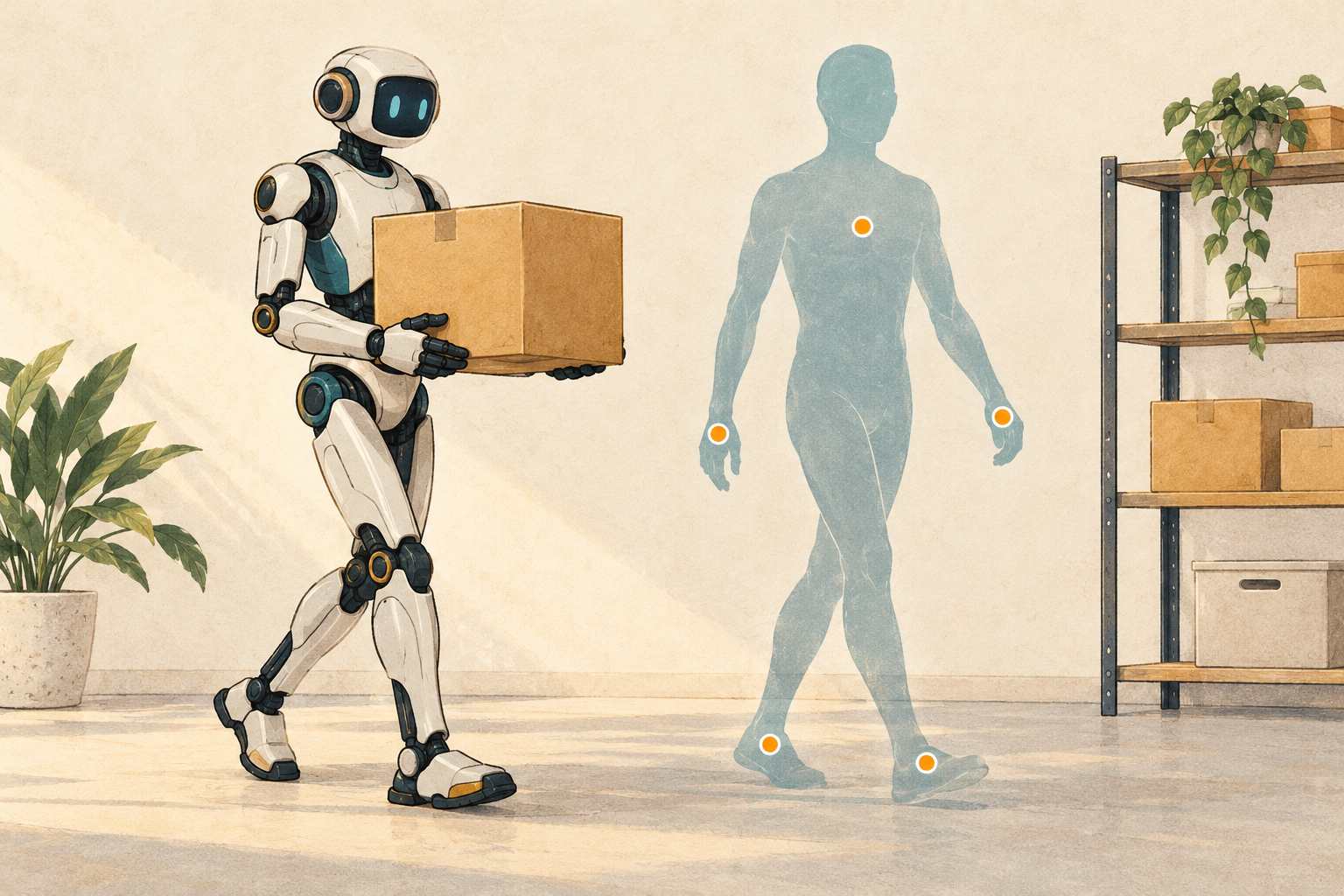
Teaching a humanoid useful physical skills can mean laboriously steering the robot through demonstrations. UC Berkeley’s Workhorse offers another route: record a person doing the work, then train a robot to sort boxes, catch one in flight and climb onto a suitcase. The promising part is the teaching method. The suitcase gymnastics are a bonus.
One demonstrator wore five motion trackers and a chest camera. The recordings totaled 2.2 hours of box sorting, 1.2 hours of suitcase work and 13 minutes of catching. Human effort is still very much in the loop, just collected without driving a robot through every lesson. Think practical class, with unusually thorough attendance records.
Two learned components turn those recordings into action. A visual planner proposes positions and orientations for the torso, wrists and feet; a reinforcement-learning whole-body controller, trained in simulation, follows them. Training includes deliberately introduced errors to help the two cope with imperfect execution. Recorded images are also edited to replace the human’s visible body with a rendered robot.
In the real demonstrations, a Unitree G1 sorts boxes using its hands and a kick, catches a thrown box, and topples and climbs a suitcase. During box sorting, it also recovers after pushes or having a box taken away. During these tasks, its camera and body sensors supply the observations, without live teleoperation. The planner runs on an external laptop. Each task has separately trained software.
The numbers need their own label. In a simulated room, the G1 completed box sorting in 77 of 100 trials without pushes, placing all three boxes within two minutes without falling. With repeated pushes, success fell to 64%, and the robot fell in 15% of trials. These are simulation results. The hardware demonstrations establish capability, not a measured real-world reliability rate.
The team posted the work as an arXiv preprint on October 6. Its scope is narrow: one demonstrator, one room and three tasks. Testing in unfamiliar settings remains an important next step. A warehouse, living room or crowded workplace would bring its own syllabus, including plenty of surprise quizzes.
The equal-contribution authors are Songbo Hu and Qiayuan Liao. Hu’s background includes undergraduate research at Tsinghua and a Stanford internship in robotics and learning-based control. Liao is a Berkeley PhD student who previously worked on reinforcement-learning control for Boston Dynamics’ electric Atlas. Their experiences span the human-demonstration and robot-control sides of the problem.
Co-author Kevin Zakka, also a Berkeley PhD researcher, focuses on large-scale simulation, transferring learned skills into the real world, and whole-body humanoid control. That last phrase sounds technical until you try carrying a box: the arms, feet and balance all need to agree on what happens next.
The useful question now is whether this teaching approach can become dependable across more people, places and jobs. Easier demonstrations could give researchers a more practical way to collect lessons. For the rest of us, the appeal is simple: useful robots should be easier to teach than a colleague who insists they already know where everything goes.
Sources
- Workhorse project: demonstrations and training setup
- Workhorse paper: October 6, 2026 arXiv preprint
- Workhorse full paper: evaluation and limitations
- Songbo Hu: official research biography
- Qiayuan Liao: official research biography
- Kevin Zakka: official research biography
Original AI-generated conceptual illustration / Actually Good News. Human-demonstration learning, shown conceptually; not the actual Workhorse hardware.