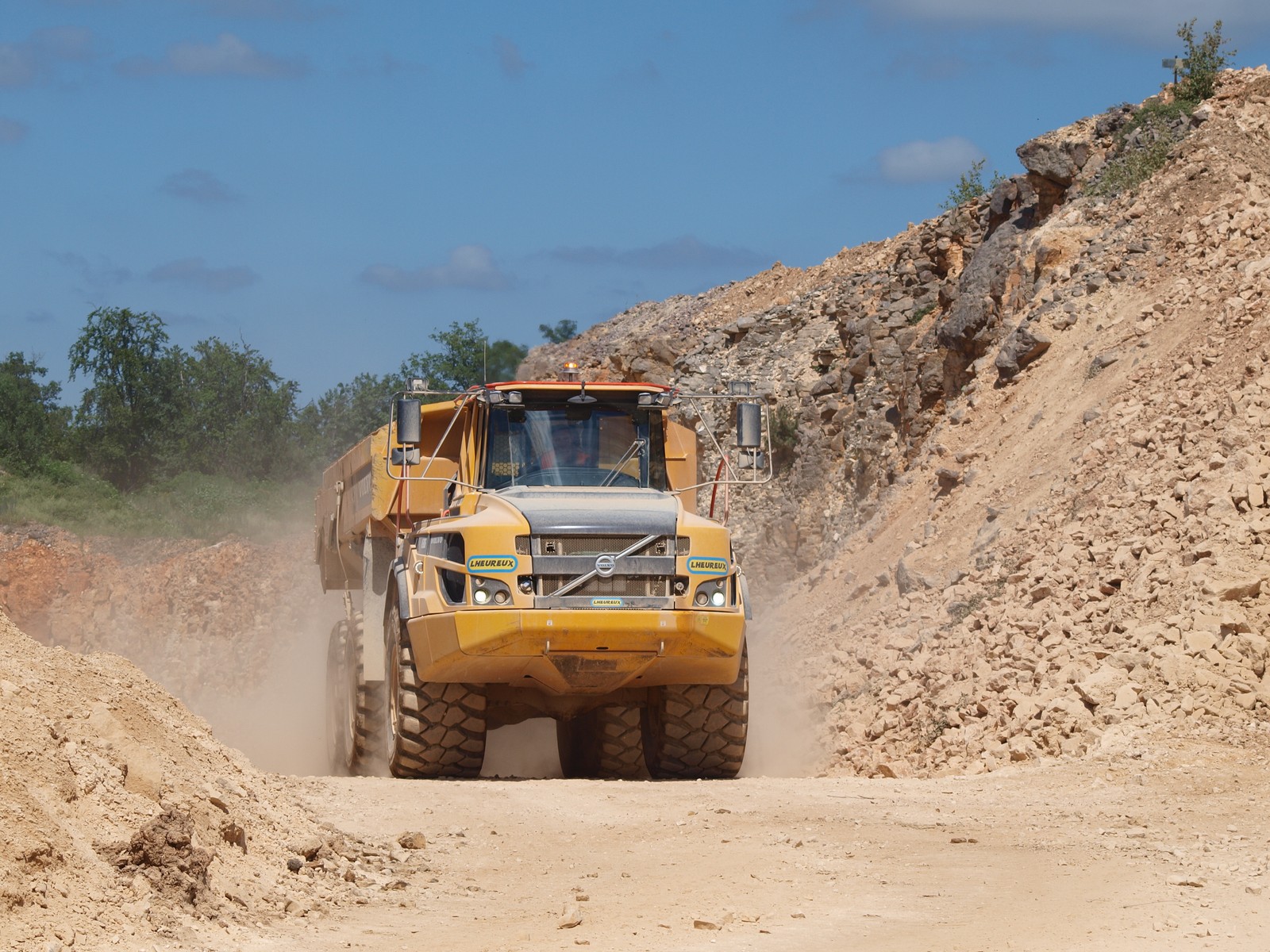
At Norway’s Brønnøy Kalk quarry, the working day starts with people inspecting trucks. A human wheel-loader operator calls a truck into position and fills its trailer with limestone. Then the truck takes the load to the crusher with nobody behind the wheel.
That routine has become part of a substantial tally. On September 24, Volvo Autonomous Solutions announced that its trucks had hauled more than three million tonnes of material autonomously across its current and completed mining and quarrying customer sites in Europe. The figure is a cumulative, company-reported total, covering several operations rather than a single mine’s annual output.
Brønnøy Kalk is one of the clearest examples of that work. Volvo says nine autonomous trucks now follow a five-kilometer quarry-to-crusher route with long tunnels and steep inclines. Driverless hauling there began in 2023, and the site passed one million tonnes in 2025.
A completed job in Sweden provides another concrete result. In a June 4 announcement, mining company Boliden confirmed the end of an autonomous transport project at its Garpenberg site. It reported close to 700,000 tonnes of rock fill moved from a quarry to reinforce a dam, across more than 11,000 transport cycles and 56,000 kilometers. That is customer corroboration of a specific project, although it comes from the companies involved rather than an independent audit.
The people around the trucks remain essential. In an April account of Brønnøy Kalk, Volvo operations manager Mikael Nyth described crews handling inspections, loading, refueling and maintenance, alongside fleet management. A truck needing attention can be taken out of service while others continue hauling. The machinery does a repeatable transport job within an organized industrial operation.
Volvo packages the equipment and support as a transport service called Autona / earth, bringing together the trucks, driving software, site infrastructure and operations support. The company says keeping people out of hazardous haulage areas is a safety benefit. The sources reviewed for this story do not establish an independently verified reduction in injuries or costs, and they do not independently audit the three-million-tonne total.
The encouraging evidence is the work already recorded: years of quarry hauling and a completed dam-construction assignment. Moving heavy material through demanding sites is a practical test for autonomy. Here, the progress can be measured in loads delivered.
Sources
- Volvo Autonomous Solutions: three-million-tonne announcement, September 24, 2026
- Mikael Nyth, Volvo Autonomous Solutions: a day at Brønnøy Kalk, April 30, 2026
- Boliden: completion of autonomous transport at Garpenberg, June 4, 2026
- Volvo Autonomous Solutions: removal of the safety driver at Brønnøy Kalk, August 30, 2023
Photo: François GOGLINS, “Camion-tombereau de carrière-01.jpg” / Wikimedia Commons, CC BY-SA 4.0. Resized from 3648×2736 to 1600×1200 and re-encoded as a quality-90 progressive JPEG with 4:2:0 chroma subsampling. EXIF orientation normalized (original orientation was 1); metadata stripped from delivery. Uncropped; no content, color or exposure edits.