An eight-person crew working on West Virginia’s eastbound Oakvale Bridge completed its rebar operation in seven shifts against a budget of 12.5, according to Advanced Construction Robotics. That is 44% fewer shifts than planned for this part of the job, with specialized machines helping move and tie the steel. A construction schedule had a better week than expected.
The manufacturer’s case study identifies Brayman Construction as the contractor and Ironworkers Local 787 as the union. Two robots shared the workload: IronBOT handled placing reinforcing bars, while TyBOT fastened intersections. ACR reports that the machines placed about 98% of the deck’s rebar by weight and made 75% of the required ties.
The division of labor is worth a closer look. Reinforcing steel has to be positioned before concrete is poured, with bars tied together to hold the arrangement. A bridge deck can turn that into a very long sequence of similar movements. It is exactly the sort of work where doing the next repetition reliably matters more than having a sparkling personality.
ACR describes IronBOT as a machine that lifts, carries and places bars under a robot supervisor’s guidance. The supervisor sets its starting position and spacing and helps separate individual bars from a bundle. After each placement, the machine advances to the next position. People remain involved in preparing the work, operating the equipment and handling the pieces the system does not cover.
TyBOT tackles the tying. According to ACR’s product information, it navigates its work area without a preloaded map and can work across both upper and lower layers of reinforcing steel. The company’s service offering still includes workers for manual installation tasks and robot supervisors. This is a crew using specialized equipment, with human judgment and coordination still very much on the job description.
There is a serious reason to care about those repetitions beyond the calendar. A National Institute for Occupational Safety and Health study of rebar tying found that manual work at ground level involved sustained deep bending and repeated, forceful wrist and forearm movements. Powered hand tools reduced some of those exposures. That research explains the interest in better tools; it did not test these robots or establish an injury reduction at Oakvale.
The schedule result also has a boundary. ACR compared actual performance with a planned budget, rather than running a controlled comparison between otherwise identical crews. Its account does not establish how much the whole bridge project accelerated, what the equipment cost or whether injuries fell. Those questions require additional evidence. Readers should treat this as a vendor-reported field result.
Even within that scope, it is an encouraging example of automation doing a specific, useful job alongside skilled workers. Placing bars and making ties are necessary steps toward a finished bridge. Getting through that stage in fewer shifts could give contractors more room in their schedules, if similar performance holds on other sites. The next test is repetition at the project level: more crews, more bridges and results that stand up to comparison.
Sources
- ACR: Oakvale Bridge project figures and budget comparison
- ACR: IronBOT operation and human supervision
- ACR: TyBOT operation and remaining manual tasks
- NIOSH: study of manual and powered rebar-tying techniques
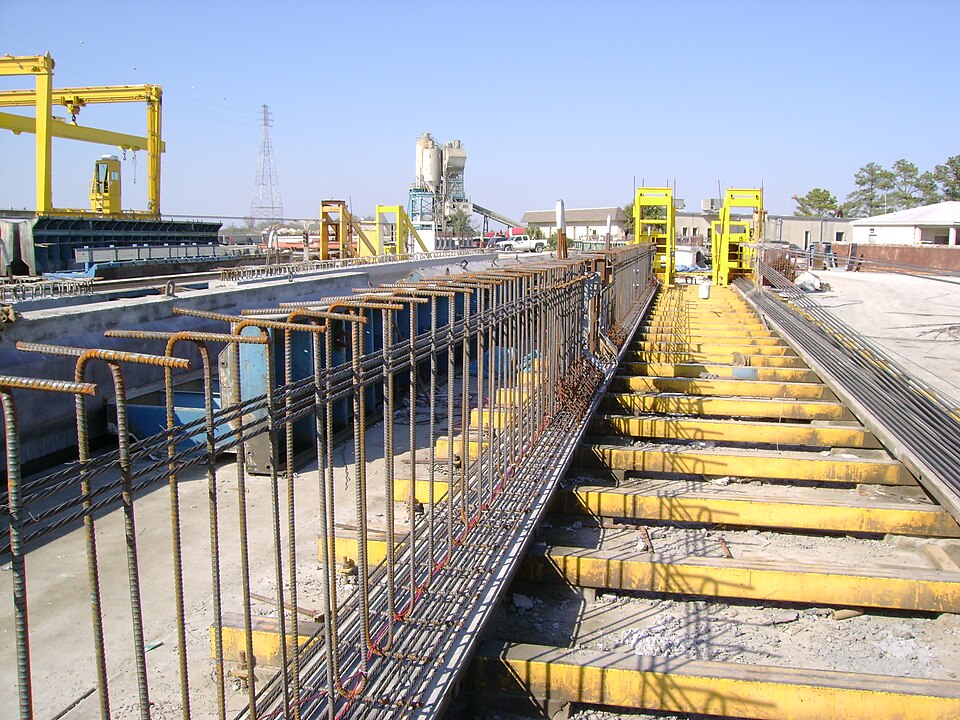
Photo: Federal Highway Administration, “Beam Rebar_SC” / Wikimedia Commons, CC BY 2.0. Uncropped reduced-size rendition provided by Wikimedia Commons; no local image edits.